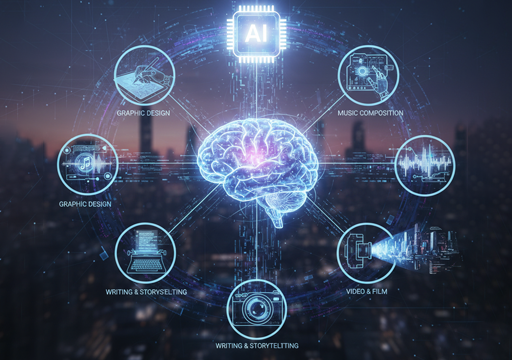

Imagine a painter inputting a text prompt instead of applying the first brushstroke to a canvas, or a musician brainstorming new chord progressions with an AI assistant. This is no longer the distant future; it is the reality of creative work today.
Artificial Intelligence (AI) is more than a mere tech buzzword; it is a powerful collaborator revolutionizing every corner of the creative sphere. The discussion has shifted from “Will AI replace jobs?” to a nuanced exploration of precisely how AI is changing creative industries by redefining workflows, fostering novel forms of expression, and democratizing access to professional-grade tools. This post offers a comprehensive analysis of these transformative shifts in 2025 and beyond.
AI vs. Human Creativity: A Symbiotic Relationship
The traditional perception was that creativity stemmed solely from human emotion, intuition, and personal experience. AI, relying on data and patterns, didn’t seem to fit this paradigm. Today, that duality has morphed into a powerful synergy. The best outcomes arise from human-AI collaboration, where the human provides the strategic direction and the AI handles the execution and scale.
| Aspect | AI’s Strength | Human’s Strength | Outcome of Collaboration |
|---|---|---|---|
| Generation | Speed, volume, pattern recognition | Originality, emotional depth, cultural context | Rapid ideation and richer execution |
| Efficiency | Automation of repetitive tasks | Strategic thinking, project management | Streamlined workflows and faster launches |
| Personalization | Data-driven customization | Empathy-based storytelling | Hyper-personalized, yet authentic user experiences |
1. Visual Arts and Graphic Design: From Prompt to Pixel
Graphic design was one of the first fields where AI’s impact became visibly clear. In 2025, AI-powered tools function as indispensable virtual studio assistants, making professional branding accessible to a wider audience.
- Rapid Ideation & Prototyping: Tools like Midjourney, DALL·E, and Adobe Firefly generate stunning visuals from text prompts in seconds. This capability allows designers to explore countless styles and concepts instantly, making real-time testing a reality.
- Efficiency Boost: AI has automated time-consuming tasks like background removal, image enhancement, and automated layout suggestions. This shift frees designers to focus on high-level concept development and complex problem-solving.
- Focus on Creativity: The core role of a designer is changing. Instead of manual labor, their focus shifts to defining the creative vision, ensuring brand consistency, and infusing designs with a human-centric approach that an algorithm cannot replicate.
2. Music and Sound Production: New Soundscapes
In the music industry, AI usage extends far beyond the recommendation algorithms seen on Spotify or Apple Music; it has integrated into the very core of composition and production.
- AI as a Co-Songwriter: Projects from Google’s Magenta and companies like AIVA help musicians use AI as a creative partner. Musicians can input parameters like mood, tempo, or genre, and the AI generates unique chord progressions, melodies, or sound effects, providing a new dimension for experimentation.
- Voice Cloning & Artist Rights: One of the more contentious developments of 2025 is sophisticated voice cloning. Major labels like Universal Music Group are actively involved in establishing guidelines to protect artist rights and intellectual property, a critical ethical consideration.
- Hyper-Personalization: AI-powered platforms are creating dynamically tailored listening experiences for users, making music discovery more immersive and personal.
3. Writing and Content Creation: Drafting Better, Faster
From blog posts to marketing copy, AI has changed the content creation game.
- Overcoming Creative Blocks: AI writing tools quickly generate first drafts, eliminating the fear of the blank page and providing a solid starting point.
- Efficient Editing & SEO: AI checks for grammar, clarity, and readability. It also assists in optimizing content for search engines, increasing visibility. However, the human writer remains essential for injecting emotional depth, nuance, and authenticity that only personal experience can provide.
- The 30% Rule: A simple guideline emerging in educational and professional settings is the “30% AI rule,” which suggests that no more than 30% of a creative work should come directly from AI tools to ensure sufficient human authorship for copyright and quality control.
4. Film and Animation: Post-Production Revolution
In the film industry, AI is significantly speeding up behind-the-scenes processes.
- Streamlining Workflows: In post-production, AI automates time-consuming tasks such as color correction, video editing, and special effects (VFX), giving filmmakers more bandwidth for artistic decision-making.
- Audience Insights: Hollywood studios are utilizing AI for script analysis and predicting audience preferences, enabling data-driven decisions in content development and risk management.
Ethical Considerations and the Path Forward
The shifts brought by AI offer immense possibilities alongside serious challenges:
- Intellectual Property and Copyright: A major concern revolves around the training of AI models on existing human works. The U.S. Copyright Office has clarified that AI-generated works without sufficient human authorship cannot be copyrighted, leading to complex ongoing lawsuits in 2025.
- Job Market Shifts: The World Economic Forum’s Future of Jobs Report 2025 reveals a dynamic landscape where AI will displace 9 million jobs but create 19 million new ones, emphasizing a net positive gain if workers adapt their skills.
- Human-Centric Approach: We must ensure AI is used responsibly to avoid losing the “heart and soul” of the creative industries.
The future requires a harmonious collaboration between AI and humans. AI provides data analysis, speed, and scalability, while humans contribute empathy, cultural context, and critical thinking.
Conclusion and Your Next Step
It is clear that AI is profoundly changing the creative industries. It is about augmentation, not replacement. The global generative AI market is projected to reach approximately $37.89 billion by the end of 2025, a testament to its staying power.
This shift, while disruptive, presents a monumental opportunity for adaptation and innovation for those who are prepared.
Are you ready to be a part of this creative revolution?
Share your thoughts in the comments below! How do you plan to integrate AI into your creative workflow? For more insightful content and industry updates, explore other articles on our